
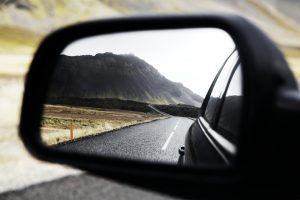
Imagine trying to drive your car while staring into the rear view mirror. Your eyes are fixed on the road behind you, on everything you've already passed, while the road ahead goes completely unseen. You'd be tense, braced for a crash, unable to move forward with any confidence, because all your attention is on what's behind. It would be exhausting, frightening, and frankly impossible to get anywhere. And yet this is exactly what living with unprocessed trauma can feel like.
I'm Rebecca Muller, a BABCP and EMDRUK accredited trauma therapist based in North Berwick, East Lothian, working online with clients across the UK and globally. In nearly thirty years of working with trauma, I've found that this image resonates deeply with people. So many of those I work with are, in a very real sense, driving through life with their eyes locked on the rear view mirror, pulled constantly back to what happened, reliving it, unable to focus on the road ahead. If that's you, I want you to know there is a way to turn your gaze back to the windscreen. EMDR therapy can help you face forward again.
Driving With Your Eyes On The Mirror
When we've experienced something traumatic that hasn't been fully processed, the past has a way of staying stubbornly present. The memory intrudes without warning. Flashbacks pull us back into moments we'd give anything to leave behind. We find ourselves reliving, replaying, ruminating, as though the event were still happening now rather than safely behind us. In the language of our metaphor, our eyes are locked on the rear view mirror, and we can't seem to look away.
This is one of the most distressing aspects of trauma: the sense that you're not really living in the present at all but trapped in something that already happened. It makes the future hard to see, let alone move towards. Plans, hopes, relationships, the ordinary business of driving forward through life, all become difficult when your attention is pinned behind you. And again, I want to be clear: this isn't a weakness or a choice. When a memory hasn't been processed, the brain keeps it 'live,' which is precisely why it keeps demanding your attention in the mirror.
Why You Can't Just 'Look Forward'
Well meaning people often tell those who've experienced trauma to 'move on,' 'look forward,' or 'leave the past in the past.' If only it were that simple. You cannot safely drive forward while something keeps wrenching your gaze back to the mirror and willpower alone rarely releases that pull. The reason the past keeps demanding your attention is that it hasn't been fully processed and filed away. Until that happens, it stays live, and it keeps calling you back.
So the answer isn't to try harder to ignore the mirror. It's to process what's back there, so that it finally settles into the past where it belongs. Once that happens, the pull eases naturally, and you find you can face forward again without constantly being dragged back. This is the heart of what EMDR does. Think of it like this: EMDR doesn't tell you to ignore the mirror and force your eyes forward. It helps settle what's behind you into the past, so the pull eases and you can face the road ahead again.
How EMDR Helps You Face Forward
EMDR, otherwise known as Eye Movement Desensitisation and Reprocessing, is a structured, evidence based therapy recommended by NICE and available on the NHS for trauma and PTSD. It works by gently helping your brain reprocess the stuck traumatic memory, so that it can finally be filed where it belongs: in the past. The memory isn't erased, you don't lose it, but it stops being 'live.' It stops ambushing you in the mirror. It becomes something you can glance at when you choose to, rather than something that constantly pulls your gaze backward.
As this happens, clients describe a profound shift. They begin to feel present in their own lives again. The future, which had felt closed off or impossible to see, opens back up. They can make plans, be with the people they love, and move forward with a confidence that trauma had made impossible. The road ahead comes back into view. And they discover that the past, once processed, becomes exactly what it should be: behind them, a part of their story, but no longer the thing they're forced to stare at while they try to live.
The Road Ahead Is Still Yours
If you've been living with your eyes fixed on the rear view mirror, braced and exhausted and unable to move forward, I want to leave you with this: the road ahead is still there, and it's still yours. You don't have to keep driving through life staring backward. With the right support, the past can be gently settled where it belongs, your gaze can return to the windscreen, and you can move forward into a future that is once again open to you.
Frequently Asked Questions About EMDR And Moving Forward
Why does trauma make me feel stuck in the past?
When a traumatic memory hasn't been fully processed, the brain keeps it 'live' rather than filing it as past. This is why it can intrude through flashbacks, reliving and rumination, making it feel as though the event is still happening now. EMDR helps the memory settle into the past so this eases.
Can EMDR help with flashbacks and reliving?
Yes. EMDR is specifically designed to reprocess the stuck memories that drive flashbacks and reliving. As those memories are processed and filed into the past, they typically lose their power to intrude, so you can feel more present in the here and now.
Will I lose the memory of what happened?
No. EMDR doesn't erase your memories. It helps them settle into the past so they no longer constantly pull your attention backward. You can still recall what happened, but it stops dominating your present and keeping you from moving forward.
Ready To Face The Road Ahead?
If you've been living with your eyes fixed on the past, unable to move forward, EMDR can gently help you face the road ahead again. I offer a free, no pressure initial telephone conversation to talk through whether it might be right for you. I currently hold a small waiting list, and I'll help you prepare so that when we begin, you're ready. Whenever the time feels right, I'd be glad to hear from you.
Rebecca Muller, BABCP & EMDRUK Accredited Trauma Therapist, offering online EMDR and Trauma Focused CBT across the UK and globally from North Berwick, East Lothian.
If this resonated with you, you might also like to read Seeing The Wood For The Trees: How Trauma Narrows Your View, And How EMDR Widens It Again, where I explore how EMDR restores perspective, and The Tortoise, Not The Hare: Why Slowing Down Is The Fastest Way To Heal, where I look at the gentle pace that makes lasting recovery possible.